


Best eSIM for Europe travel in 2026
Roaming charges in Europe can wipe out your travel budget before you’ve even ordered your first coffee. Swapping physical SIM cards at every border is fiddly, time-consuming, and easy to get wrong. The best eSIM for Europe travel solves all of that. You buy a plan online, install it on your phone before you leave home, and you’re connected the moment your plane lands. No queues at airport kiosks. No tiny SIM card trays. This guide walks you through every eSIM type, key selection criteria, top providers, and a step-by-step setup process so you travel with confidence.
Table of Contents
- Key takeaways
- Best eSIM for Europe travel: plan types explained
- How to choose the right Europe eSIM
- Setting up your eSIM: a step-by-step guide
- Top eSIM providers for Europe compared
- Troubleshooting and tips for smooth connectivity
- My take on eSIMs for Europe travel
- Stay connected across Europe with Esim4u
- FAQ
Key takeaways
| Point | Details |
|---|---|
| Install before you fly | You can set up your eSIM at home on Wi-Fi and it activates only when you land in Europe. |
| Regional plans beat country plans | A single multi-country eSIM covers 35 to 42 countries without reinstalling at each border. |
| Match the plan to your usage | Heavy users should choose unlimited plans; light travellers save money with capped data options. |
| Verify device compatibility first | Not all phones support eSIM, so confirm your model before purchasing any plan. |
| Subscription models suit frequent travellers | Install-once subscription plans remove the need to buy and set up a new eSIM every trip. |
Best eSIM for Europe travel: plan types explained
Not all Europe eSIMs are built the same. Understanding the types available helps you pick the right one for your trip from the start.
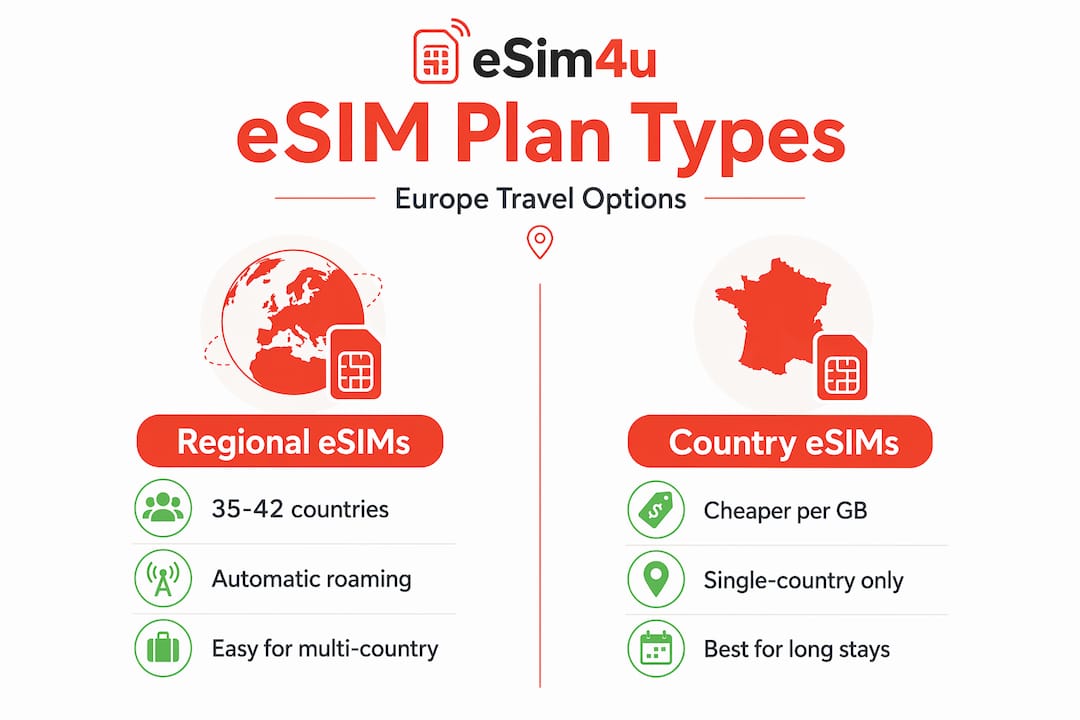
Regional eSIMs cover a broad range of countries under one plan. Regional Europe eSIMs cover 35 to 42 countries and auto-switch networks when you cross a border, all from one installed profile. This is the most practical option if you’re visiting multiple countries, which most European trips involve.
Country-specific eSIMs are cheaper per GB but only work in one country. They make sense if you’re spending three weeks in Italy and going nowhere else.
Subscription models like Nomad Pass take a different approach entirely. Nomad Pass offers a $3 per month subscription that keeps a persistent eSIM installed on your device with 1GB of baseline data refreshed every 30 days. You never need to buy or reinstall a plan between trips. For Australians who visit Europe two or three times a year, this is genuinely useful.
Here’s a quick breakdown of the main plan types:
- Regional multi-country plans: Best for travellers crossing multiple borders. One install, one plan, no switching.
- Country-specific plans: Best for single-destination trips where you want the lowest cost per GB.
- Unlimited data plans: Best for heavy users who stream, video call, or work remotely. No daily caps.
- Subscription plans: Best for frequent travellers who want a permanently installed eSIM ready to go.
Coverage nuances matter too. Most regional Europe eSIMs cover major EU states plus the UK, Switzerland, Norway, and Iceland, but coverage in the Balkans and Kosovo varies significantly by provider. Always check the exact country list before you buy, especially if your itinerary includes less-visited destinations.
Pro Tip: If your trip includes countries like Albania, Kosovo, or North Macedonia, confirm coverage explicitly with your provider before purchasing. These destinations are frequently excluded from standard regional plans.

How to choose the right Europe eSIM
Picking the best plan comes down to matching it to your specific trip. Here are the key factors to work through before you buy.
-
Trip duration. A 7-day plan suits a short city break. For a 3-week multi-country trip, look for 30-day plans with enough data to last. Some providers offer 90 and 180-day options for extended stays.
-
Data needs. Think honestly about how you use your phone while travelling. Checking maps and messaging uses very little data. Streaming music, uploading photos, or working remotely uses a lot. A rough guide: 1 to 3GB suits light use, 5 to 10GB suits moderate use, and unlimited plans suit heavy users.
-
Number of countries. If you’re visiting more than two countries, a regional plan almost always works out cheaper and simpler than buying separate country plans.
-
Budget. Cost per GB varies widely across providers. Unlimited plans cost more upfront but remove the anxiety of running out of data mid-trip.
-
Ease of installation. Most good providers let you install the eSIM profile at home on your own Wi-Fi before departure. Activation only begins when your phone connects to a European network, so you don’t lose any validity days sitting at home.
-
Extra features. Some plans include hotspot tethering, which is useful if you’re travelling with a laptop.
Pro Tip: Always check whether hotspot tethering is included in your plan before you buy. Some providers restrict it or charge extra, which matters a lot if you plan to use your phone as a Wi-Fi hotspot for a tablet or laptop.
Setting up your eSIM: a step-by-step guide
Getting your eSIM ready before you travel is straightforward. Here’s exactly how to do it.
-
Check device compatibility. Confirm your phone supports eSIM. Most iPhones from XS onwards and many recent Android models do. Check your phone’s settings or the manufacturer’s website if you’re unsure.
-
Purchase your plan online. Buy from a reputable provider. You’ll receive a QR code by email shortly after purchase.
-
Install the eSIM profile on Wi-Fi. Do this at home before you leave. On iPhone, go to Settings > Mobile Data > Add eSIM, then scan the QR code. For Android, the path varies slightly by manufacturer. Esim4u provides dedicated guides for iPhone eSIM setup and Android eSIM installation to walk you through each step.
-
Label your eSIM profiles. If you have your Australian SIM and a Europe eSIM on the same device, label them clearly so you know which is which.
-
Set data roaming correctly. Before landing in Europe, set your Europe eSIM as the default data line. Keep your Australian SIM active for calls and SMS if needed, but turn off data roaming on it to avoid accidental charges.
-
Activate on arrival. eSIM plans activate only once your phone connects to a European network, so your validity countdown starts when you land, not when you install. This means you can install weeks before your trip without wasting a single day of your plan.
-
Verify connectivity at the airport. Open a browser or send a message as soon as you land to confirm everything is working before you leave the terminal.
| Step | When to do it | Device path |
|---|---|---|
| Check compatibility | Before purchasing | Settings or manufacturer website |
| Buy plan and get QR code | 1 to 7 days before travel | Provider website |
| Install eSIM profile | At home on Wi-Fi | Settings > Mobile Data > Add eSIM |
| Set default data line | Before boarding | Settings > Mobile Data |
| Verify connection | On arrival | Open browser or maps app |
Pro Tip: Installing your eSIM before departure on stable home Wi-Fi and relying on activation on arrival removes a major source of travel stress. You step off the plane already connected.
If you’re also planning trips beyond Europe, it’s worth knowing that comparable eSIM options exist for other regions. Whether you need the best eSIM for Americas travel, best eSIM for Asia travel, or best eSIM for south America travel, the same principles apply: check coverage, match data to your usage, and install before you fly. Australians travelling abroad have genuinely good europe travel esim options available right now, and the market keeps improving.
Troubleshooting and tips for smooth connectivity
Even with the best preparation, small issues can come up. Here’s how to handle them.
- eSIM not activating on arrival. Toggle aeroplane mode off and on. This forces your phone to search for a network. If it still doesn’t connect, check that your Europe eSIM is set as the active data line in your settings.
- Slow speeds in a specific country. Your eSIM connects to a local partner network. If speeds are poor, check whether your provider supports multiple network partners in that country. Some providers only partner with one carrier per country, which limits your options if that network is congested.
- Running low on data. Most providers let you top up through their app or website without reinstalling the eSIM. Buy a top-up before you hit zero to avoid any gap in connectivity.
- Unexpected charges on your Australian SIM. Turn off data roaming on your home SIM the moment you land. Even a brief accidental connection to a roaming network can trigger charges.
- Managing two eSIM profiles. If you have both a home eSIM and a travel eSIM installed, make sure only one data line is active at a time. Label each profile clearly so there’s no confusion.
Pro Tip: Screenshot your eSIM QR code and store it in your photos before you travel. If you lose the email from your provider, you’ll still have the code to reinstall if needed.
My take on eSIMs for Europe travel
I’ve watched the eSIM market grow from a niche tech option into the obvious choice for most travellers. What strikes me most is how much simpler the install-once and subscription models have made things. The old way, buying a local SIM at every destination, was genuinely stressful. You’d land exhausted, queue at a kiosk, hope they had stock, and then spend 20 minutes figuring out how to swap a tiny card without losing it down an airport drain.
The misconception I still hear regularly is that eSIMs are complicated to set up. They’re not. If you can scan a QR code, you can install an eSIM. The process takes about three minutes on a stable Wi-Fi connection.
What I think most travellers underestimate is the value of installing early. The fact that validity only starts on first European network connection means you can install your eSIM a week before departure, test that it’s sitting correctly on your device, and travel knowing everything is ready. That peace of mind is worth more than any feature comparison table.
My honest advice: if you visit Europe once a year, pick a solid regional plan from a reputable provider and install it before you fly. If you visit two or more times a year, look seriously at subscription options. The install-once eSIM model removes the entire purchase and setup process from every subsequent trip. That’s a genuinely useful improvement for frequent travellers.
Stay connected across Europe with Esim4u
Finding the right plan is easier when you have a trusted place to start. Esim4u offers a range of Europe and UK eSIM plans covering 30 countries, with options suited to short city breaks and longer multi-country trips alike. Plans work on both Apple and Android devices, and Esim4u provides clear installation guides so you’re never left guessing.
Whether you’re after a flexible data plan for a fortnight in Europe or you want to explore unlimited options for a longer trip, Esim4u has you covered. Browse the full range of international eSIM plans and get set up before your next departure. Installation takes minutes. Connectivity starts the moment you land.
FAQ
What is the best eSIM for Europe travel in 2026?
Ubigi is widely recommended as the best overall option, with a 25GB plan for USD $32 over 30 days offering strong value, coverage, and reliability across Europe.
Can I install a Europe eSIM before I leave Australia?
Yes. You can install your eSIM at home on Wi-Fi and it will only activate when your phone first connects to a European network, so you don’t lose any validity days before you travel.
How many countries does a Europe eSIM cover?
Most regional Europe eSIMs cover between 35 and 42 countries, including EU nations plus the UK, Switzerland, Norway, and Iceland. Coverage in the Balkans varies by provider, so check the country list before purchasing.
Is an unlimited Europe eSIM worth it?
For heavy data users who stream, video call, or work remotely, unlimited plans without daily caps are worth the extra cost. Holafly’s unlimited 7-day plan at €26.90 is a strong option with no throttling.
Do I need a different eSIM for each European country I visit?
No. A regional multi-country eSIM covers the entire itinerary under one plan and auto-switches networks at each border, so there’s no need to buy or reinstall a new plan for each country.
Related Blogs
Explore the World Without Roaming Worries



100% Money Back Guarantee
If you cancel your trip or experience tech issues that we can’t fix; we’ll refund you 100%.