


eSIM for family travel plans: your 2026 guide
An eSIM is a digital SIM card embedded directly into your device, letting you activate a mobile data plan remotely without touching a physical SIM. For families heading overseas, this technology removes one of the most frustrating parts of international travel: sorting out mobile connectivity for every person in the group. Instead of queuing at airport kiosks or hunting for local SIM cards on arrival, you can set up travel eSIM plans for every family member before you leave home. Providers like eSIM4u.com.au offer plans covering single countries, regions, and even global destinations, giving Australian families real flexibility on cost and coverage.
How eSIMs work for family travel plans with multiple devices
Each family member needs their own eSIM profile installed on their individual device. There is no single “family account” that distributes data automatically across phones and tablets. Instead, each person activates a plan suited to their device and usage needs, which actually gives you more control over costs.
Before you buy, check two things for every device in your family:
- eSIM compatibility: Most modern smartphones support eSIM, including iPhone XS and later, Google Pixel 6 and later, and Samsung Galaxy S21 and later. Tablets like the iPad Pro (2018 onwards) also support eSIM.
- Unlocked status: A locked device cannot install a local or travel eSIM. It can only use roaming passes from the original carrier. If any family member’s phone is locked, contact your carrier to unlock it before departure.
Once each device has an eSIM installed, you can share data across the group using the hotspot or tethering function on one device. This is useful for younger kids on tablets or for a family laptop. However, hotspot permissions vary significantly between providers. Some plans block tethering entirely, which would leave shared devices without connectivity. Always confirm hotspot access is included before purchasing.
Most plans are data-only, which suits the majority of families who use messaging apps like WhatsApp or FaceTime for calls.

Pro Tip: Install each family member’s eSIM on Wi-Fi at home before you travel. This way, everyone arrives ready to connect the moment they land, with no airport stress.
What plan types are available and how do they compare?
Understanding the three main eSIM plan categories helps you match the right option to your family’s itinerary.
Local plans cover a single country and typically offer the best value for money when your family is staying in one destination. They are ideal for a two-week holiday in Japan or a month in the USA.
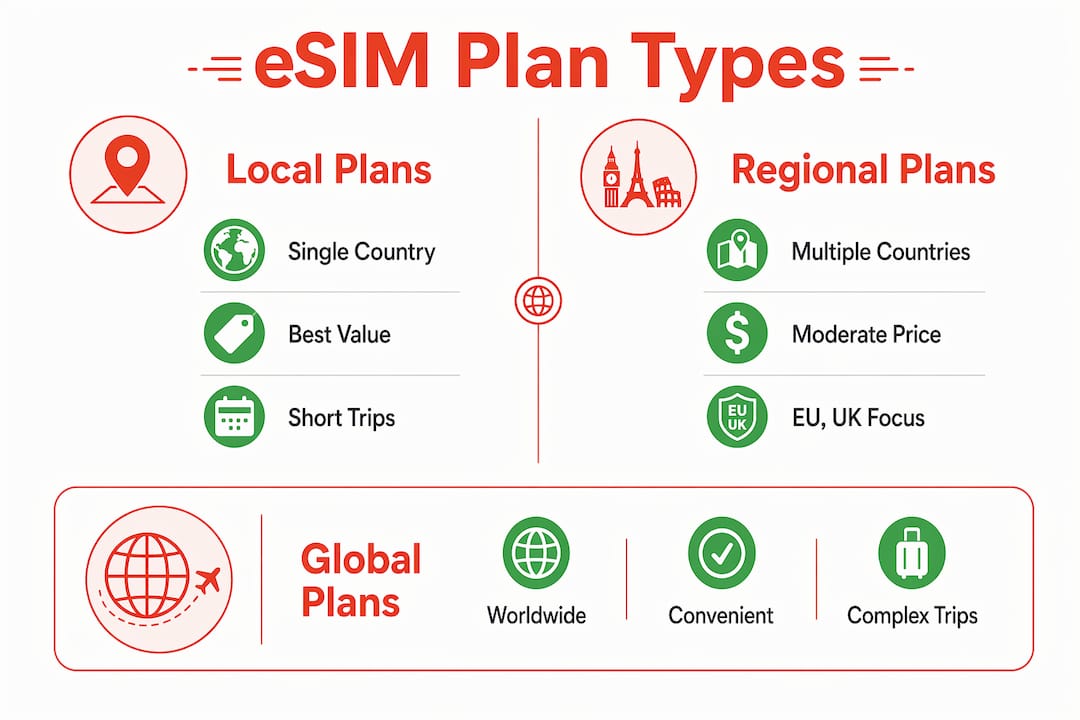
Regional plans: it cover a group of countries under one plan. These suit families doing multi-country trips without wanting to manage separate plans per destination.
Global plans: like eSIM4u Global data plan cover up to 120 countries. They are the most convenient option for complex itineraries but tend to cost more per gigabyte than local or regional alternatives.
| Plan type | Coverage | Best for | Typical duration | Calls and SMS |
|---|---|---|---|---|
| Local | Single country | Long stays, one destination | 7 to 30 days | Rarely included |
| Regional | Multiple countries in one region | Multi-stop European or Asian trips | 7 to 28 days | Occasionally included |
| Global | 100+ countries worldwide | Complex, multi-continent itineraries | 7 to 30 days | Select plans only |
Pricing varies widely. A 5GB local plan for Europe can start around AUD $10 to $15 per person, while a 10GB global plan may cost AUD $79. For a family of four, regional plans often strike the best balance between coverage and cost.
- Regional plans reduce the number of separate purchases and activations your family needs to manage.
- Data-only plans are cheaper and sufficient for most families using Wi-Fi calling apps.
- Unlimited plans suit heavy data users but often throttle speeds after a daily threshold.
Operational considerations families often overlook
Families tend to get tripped up not by coverage gaps but by operational details like validity timing, hotspot rules, and top-up availability. These are the details that determine whether your family stays connected or scrambles for Wi-Fi at the hotel lobby.
Here are the key operational steps to work through before and during your trip:
- Confirm activation timing. Most providers let you install an eSIM days before travel, but validity starts on the first network connection, not on installation. This means you will not waste data days while still at home on Wi-Fi.
- Check hotspot permissions. Before purchasing any plan, read the fine print on tethering. If you plan to share data from one phone to a tablet or laptop, the plan must explicitly allow hotspot use.
- Understand top-up options. Data runs out faster than expected when multiple family members are streaming maps, videos, and social media. Choose a provider that offers easy mid-trip top-ups so you are not left without connectivity.
- Know the fair-use roaming limits. For families on extended trips, UK carriers enforce fair-use roaming limits that can cause service suspension after roughly 60 days. Switching to a local or travel eSIM early avoids this disruption entirely.
- Keep your home SIM active. Many families use a hybrid approach: keep the physical Australian SIM in the device to receive two-factor authentication (2FA) codes and one-time passwords, while the eSIM handles all data and connectivity abroad. This protects access to banking apps and other secure services.
- Test before departure. Confirm the eSIM profile is installed and visible in your device settings before you leave. Troubleshooting an installation issue is far easier at home than at an international airport.
Pro Tip: Set a data usage alert on each family member’s device. Most smartphones let you set a warning at 80% of your plan’s limit, giving you time to top up before connectivity drops.
How to choose the best eSIM plan for your family’s trip
Choosing the right plan comes down to four practical factors: destination, trip length, data needs, and budget. Work through these before comparing providers.
- Destination and coverage: Check that the plan covers every country on your itinerary, including transit stops where you might want data. A regional plan for Southeast Asia, for example, may not include Japan if your family is doing a broader Asia trip.
- Trip duration: Match plan validity to your travel dates. A 7-day plan is wasted on a 14-day holiday. Look for 28-day or monthly plans for longer family trips.
- Data volume per person: A teenager streaming YouTube uses far more data than a parent checking emails. Estimate each person’s daily usage honestly. A rough guide: light use (maps, messaging) needs about 500MB per day; moderate use (social media, video calls) needs 1 to 2GB per day.
- Calls and SMS: If your family needs local phone numbers for accommodation or car hire, look for plans that include calls and SMS. Most families travelling with smartphones manage fine on data-only plans using WhatsApp or FaceTime.
- Provider support: Choose a provider with responsive customer support. If an eSIM fails to activate mid-trip, you need fast help. Check reviews for support quality, not just coverage.
- Backup plan: Always keep a backup option. This could be a roaming add-on from your Australian carrier or a physical SIM purchased on arrival. eSIMs are reliable, but having a fallback for the first few hours of a trip removes unnecessary stress.
For families travelling to Europe, regional plans covering the EU and UK offer strong value. For Asia-Pacific trips, country-specific plans often deliver better speeds and pricing than broad global options.
Key takeaways
eSIM for family travel plans works best when every device is unlocked, hotspot permissions are confirmed, and validity timing is understood before departure.
| Point | Details |
|---|---|
| Device unlock is non-negotiable | Locked phones cannot use travel eSIMs and are limited to expensive roaming passes. |
| Hotspot access must be verified | Some plans block tethering; confirm before purchase to share data across family devices. |
| Validity starts on first connection | Install eSIMs at home but do not connect to a local network until you arrive at your destination. |
| Keep home SIM active for 2FA | Your Australian SIM should remain active to receive security codes for banking and other apps. |
| Match plan type to your itinerary | Local plans suit single-country trips; regional plans work best for multi-stop family holidays. |
Why I think most families overcomplicate eSIM setup
I have helped a lot of families work through their connectivity plans before heading overseas, and the pattern is always the same. They spend hours comparing data allowances and pricing across providers, then overlook the two things that actually cause problems: hotspot permissions and activation timing.
A family of four does not need four separate 10GB plans if the parents are happy to share a hotspot with the kids’ devices. One well-chosen plan with confirmed tethering access can cover a tablet and a laptop alongside a phone. That is a real cost saving that most comparison articles never mention.
The hybrid SIM approach is also underused. Keeping your Australian SIM active while running an eSIM for data is not complicated. It is just a setting change. And it protects you from being locked out of your bank account at the worst possible moment because a 2FA code went to a number you cannot receive.
My honest advice: spend less time comparing gigabyte counts and more time reading the fine print on hotspot rules and top-up options. Those two factors will define your family’s actual experience on the road.
Get your family connected with Esim4u
Esim4u offers a straightforward range of travel eSIM plans built for families heading overseas. Whether you are travelling to Europe, the USA, Southeast Asia, or further afield, you will find global eSIM options that cover your destinations without the hassle of physical SIM cards. Plans activate instantly, and top-ups are available mid-trip so your family stays connected throughout. Setting up on Apple devices is simple, with a clear iPhone eSIM installation guide to walk you through every step. Visit Esim4u to find a plan that fits your family’s itinerary, data needs, and budget before you depart.
FAQ
Can all smartphones use an eSIM for international travel?
Most smartphones released after 2018 support eSIM, including iPhone XS and later, Google Pixel 6 and later, and Samsung Galaxy S21 and later. Your device also needs to be unlocked by your carrier before a travel eSIM can be installed.
How do families share data across multiple devices with one eSIM?
One family member can activate a hotspot on their eSIM-enabled phone to share data with tablets, laptops, or other devices. Check that your chosen plan explicitly allows hotspot or tethering, as some plans restrict this feature.
When does an eSIM plan’s validity period start?
Validity starts on the first connection to a local network at your destination, not when the eSIM is installed. You can safely install your eSIM at home on Wi-Fi without triggering the countdown.
Should families keep their Australian SIM active while using an eSIM abroad?
Yes. Keeping your home SIM active lets you receive two-factor authentication codes and one-time passwords from Australian banks and services. Use the hybrid SIM approach so your eSIM handles data while your physical SIM stays available for security messages.
What is the most cost-effective eSIM plan type for a multi-country family trip?
Regional plans offer the best balance of coverage and cost for families visiting multiple countries in one region.
Related Blogs
Explore the World Without Roaming Worries



100% Money Back Guarantee
If you cancel your trip or experience tech issues that we can’t fix; we’ll refund you 100%.